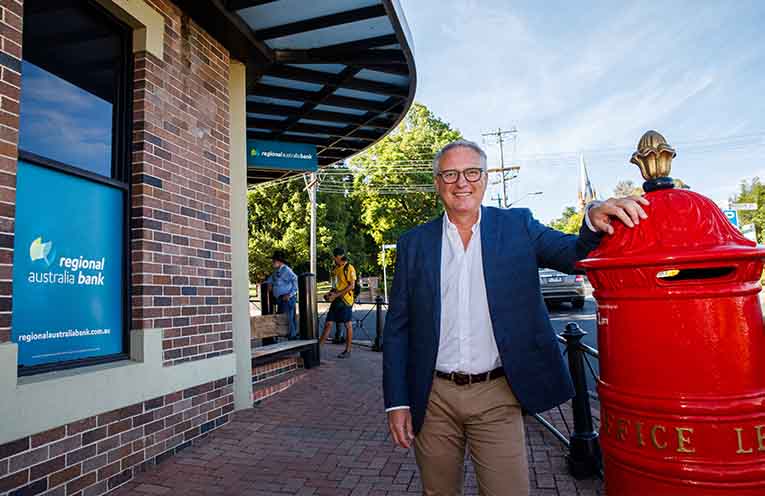
REGIONAL Australians place great value on their local face to face bank branches as employers and providers of community infrastructure, according to a new survey.
The Regional Banking Investment Alliance (RBIA) survey: Regional Banking Insights, found 97 per cent of respondents rated local bank employment as essential or important, and 95 per cent said the same of branches and shopfronts.
CEO of Central Murray Bank, Sally Eales said the findings showed regional banking policy needed to account for the wider community benefits of keeping branches open, including local jobs, support for businesses and access to trusted help.
Eales said a branch’s contribution extended beyond the transactions processed at its counter.
“A branch employs local people, gives customers a reason to come into town and supports the businesses around it,” Eales said.
“When people have to travel elsewhere to do their banking, they can take their shopping and other spending with them. The consequences of losing a branch reach well beyond the bank’s customers.”
The survey received 1,555 responses through RBIA member banks in September and October 2026. Questions on local employment and physical banking infrastructure each received 1,329 responses.
Separate questions found 97 per cent valued banks helping keep decision-making local through participation in and understanding of the local economy, while 91 per cent rated sponsorship and community programs as essential or important.
In written responses about branch closures and the importance of regional banking, customers described concerns about jobs leaving town, spending moving to larger centres and the growing burden of travelling for banking services.
One respondent reported driving 260 kilometres each way for personal banking services. Others highlighted fuel costs, time away from work and reliance on family or friends for transport, particularly for older people and people with a disability.
CEO of Regional Australia Bank, David Heine said access to banking was also a question of independence and inclusion.
“A banking service is of little use if someone cannot reliably get to it or use it. Long distances, limited transport and unreliable telecommunications can turn an ordinary banking task into a major obstacle,” Heine said.
“A local branch gives people somewhere to turn, helps them maintain their independence and provides personal support when a problem becomes urgent.”
Responses also highlighted the reassurance of having someone nearby when things went wrong. One customer described the importance of “Confidence for older Australians to not feel isolated when issues arise.”
Another raised concerns about AI replacing human interaction, trust and community connection.
RBIA said it was concerned about recent proposals from the Australian Banking Association for shared banking hubs which could lead to an erosion of services and jobs. The proposal should be assessed against its contribution to local employment, reliable access, privacy, local decision-making and ongoing community relationships, as well as the services available to customers.
The alliance renewed its call for the Federal Government to adopt its proposed Community Service Obligation to share the cost of sustaining full service face-to-face regional branches across the banking industry.
RBIA estimates the model would cost around $153 million a year across the banking industry, with no taxpayer funding.
Funding would be available on equal terms to banks with qualifying regional branches, with participation optional for smaller banks.
“Banks that earn revenue from regional Australia should contribute to the services that help those communities remain viable,” Newman said. “A lasting funding arrangement would give banks greater certainty to keep investing in local people and branches.”
Supporter of the Alliance, Glen Innes Severn Shire Council Mayor, Margot Davis recognises the importance of bank branches to regional communities.
“Bank branches are an important contributor to our local community. Beyond the service they provide, they bring professional jobs, shopfronts in the main street and community sponsorships.
“Supporting regional banking is vital, Glen Innes has already lost 3 branches since 2017. We are now starting to see reductions in hours of operation from the Big Banks and a lot of people rely on face-to-face banking services every day,” Davis said.
“Regional Australians should be able to access the services they need. It’s time for the banks and government to step up and support the regional communities who have supported them.”