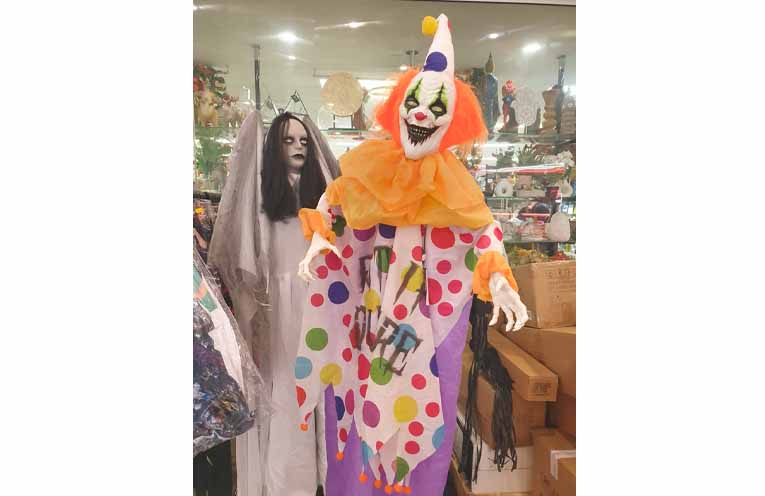
FEW calendar events are as controversial as Halloween, which takes place on 31 October each year.
It provides retail outlets with another themed merchandising opportunity, while for children and others who enjoy a party, it’s a chance to dress up and have some goulishly sweet fun.
Here, opponents often ridicule Halloween as another commercialised American cultural event, with no history in Australian culture until more recent decades.
That’s not quite true …
Halloween is a contraction of All Hallows Eve, a Christian observance dedicated to remembering the dead on October 31. It’s followed by All Saints Day on 1 November and All Souls Day on 2 November.
All Saints’ Day commemorates all Christian saints, both known and unknown, who are believed to have been received directly into heaven after their death.
All Souls’ Day was dedicated as a day of prayer for the faithful who have died.
In countries where Catholicism is the major religion, All Saints Day and All Souls Day are still observed with many of the faithful visiting cemeteries to pay their respects to their departed.
The eighth-century Pope Gregory III is credited with changing the dates of All Saints Day and All Souls Day, previously observed in May, to coincide with the Celtic pagan festival Samhain observed in ancient Ireland and Scotland.
It’s believed that the church wanted to make Christianity more acceptable to pagans by finding similarities. Samhain was a harvest festival which marked the beginning of Winter and the new year, and roughly coincided with 1 November.
It was also believed that on this day the barrier between the living and the departed diminished. Departed spirits could return to their homes, while the recently departed crossed over to the afterlife.
In some areas, people lit candles or lanterns to guide the souls on All Hallows’ Eve. Such practices meant that ghosts and spirits became associated with Halloween.
Not all spirits or ghosts were considered benign: people disguised themselves to escape notice. Today such disguises are embraced as part of the fun of Halloween.
There is an Irish story about Jack of the Lantern who deceived the devil and was locked out of both heaven and hell.
He was doomed to travel the earth carrying a lantern carved from a large turnip.
People carved out scary root vegetables like turnips and placed candles inside. When Irish immigrants brought the Halloween tradition with them to the USA, they found pumpkins made great Jack- O’-Lanterns.
Irish and Scottish immigrants in Australia also celebrated Halloween as early as the 1850s, but such events were localised. It remained that way here until the late 20th century, when its commercialisation followed in the wake of our exposure to American culture.
The term ‘trick or treat’ was first used in 1927. Following the end of sugar rationing in the early 1950’s, and thanks to the cartoon Peanuts and a Walt Disney short film ‘Trick or Treat’, candy treats at Halloween became a confectioner’s dream.
Australian children go trick or treating in the late afternoon. Although there is safety in numbers, supervision by an adult is still important.
Householders who are happy to dispense treats should tie an orange balloon to their letterbox. Or not.
By Marilyn SANDERSON