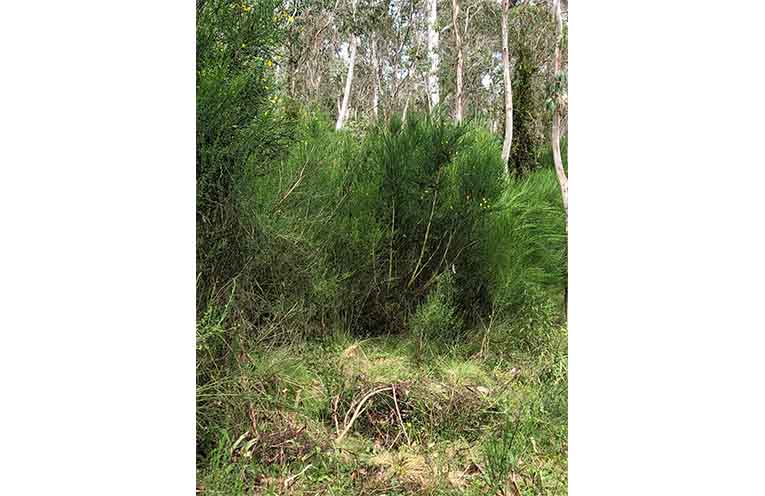
LIKE many other plant and animal pests, Scotch Broom was brought to Australia by the early European settlers.
Apparently, it was imported here in the early 1800s by Governor King as a substitute for hops, and being suited to some Australian conditions, it quickly spread.

This weed particularly enjoys parts of the World Heritage Barrington Tops, threatening many native plants and animals.
The 2014 National Parks and Wildlife Service’s (NPWS) Broom Management Manual explained that, at that time, it had infested about 10,000 hectares of the Tops, and approximately 4,500 hectares of the Barrington Tops National Park.
The manual spells out that a mature Scotch Broom plant can produce over 15,000 seeds and can generate soil seed banks of up to 50,000 seeds per square metre.
For many years after 2014, there was little to no reduction in the infested area, with efforts focused primarily on containment.
The 2019–2020 bushfires triggered widespread germination, but, ironically, also created an opportunity to secure additional funding and step up control efforts.
In mid-2024 the NPWS produced a Scotch Broom Management Strategy designed to better deal with the problem.
The Strategy’s vision is to “make the best use of resources to manage Scotch Broom effectively and efficiently within the Barrington Tops national parks, for threatened species recovery and healthy systems.”
Although it is clear that Scotch Broom can never be eliminated from the Barrington Tops, since the Strategy was prepared, with additional funding, some real progress has been made.
Gloucester National Parks Ranger Peter Beard told NOTA that the main control methods for Scotch Broom in the past had been physical removal by hand, and spraying, however recently they had been trialling larger scale removal with a mechanical muncher, and were studying the effectiveness of a biological control method in the form of a gall mite.
NOTA was invited to spend a day observing the results of the various methods of control.
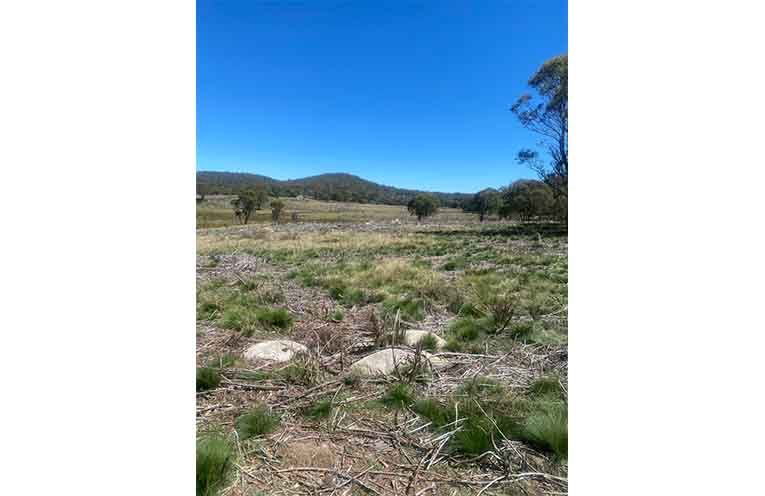
It was clear that in the last couple of years a significant area around the popular Polblue swamp had been completely cleared of Scotch Broom, through the efforts of volunteers, NPWS staff and contractors.
Close to the beautiful Junction Pools the mechanical muncher had cleared broad areas, although the muncher has so far only been employed in more open country.
NOTA was shown a number of Scotch Broom plants where gall mite had clearly impeded the growth of the infected plants, and the results, according to Peter, are promising.
Peter indicated that more Broom clearing work is in the pipeline, including trialling the muncher in more forested areas.
The plan is to first clear Broom from water courses and popular public areas and then to work outwards.
“Whether removal work can be carried out depends on many variables such as weather, access, availability of resources, plant biology and plant location,” said Peter.
“Scotch Broom can never be eliminated from the Barrington Tops, but by employing a combination of methods, some real progress is being made, but more federal and state government funding would be very welcome.”
Although much has recently been achieved, the Strategy contains this sobering message:
“However, there remains a significant need for additional funding and staff resources to reverse the impacts of many years of the growth of this vigorous weed across the park’s vulnerable ecosystems.”
By John WATTS